


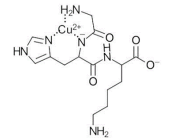
In September 2023 GHK-Cu, also known as copper peptide or glycyl-l-histidyl-l-lysine copper complex, was added to the 503A bulks list in category 1. The 503A bulks list clarifies that GHK-Cu may be compounded as a bulk drug substance by 503A pharmacies except for injectable routes of administration.1,2,3 In this blog post we will be reviewing relevant data regarding uses of GHK-Cu as well as discussing available information on stability and compatibility.
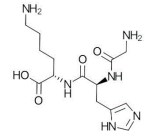
GHK-Cu is a complex of copper and glycyl-l-histidyl-l-lysine (GHK), a peptide present in human plasma, saliva, and urine that decreases in concentration as we age.4 Endogenous GHK improves tissue repair in the skin and possesses cell protective activity. Given GHK’s role in the body, GHK-Cu has been studied for a variety of uses including wound healing, alopecia, aging skin, and even cognitive decline.5 The addition of copper to GHK is thought to enhance certain enzymatic functions important for skin maintenance and repair.18 Unlike some other copper containing compounds like copper chloride or copper acetate, GHK-Cu has not been found to be cytotoxic or to cause irritation topically, making it an ideal option for delivery of copper into the skin.19
Aging Skin
GHK-Cu is another ingredient gaining increasing attention for potential topical use for aging skin. Levels of GHK naturally decline as we age and research has demonstrated that this peptide can stimulate synthesis of collagen, elastin, and glycosaminoglycans in the skin. Studies evaluating the impact of GHK-Cu applied to the face have noted reduced fine lines and wrinkle depth. GHK-Cu under eye creams have been found to be superior to vitamin K creams for improved skin appearance and increased skin density and thickness. In addition to use on the face, one study of GHK-Cu applied to the skin of the thigh also noted improvement in lines, wrinkles, skin density, and even improvements in mottled pigmentation.5 Much of the human data on topical GHK-Cu is from studies that do not specify the concentration used, however, generally products have been used in cosmetic preparations at concentrations between 0.2-2%.6
Wound Care
One open label dose finding study on GHK-Cu in patients with diabetic ulcers compared 0.03%, 0.3%, and 3% GHK-Cu injection to saline for patients with diabetic ulcers over a 15-day period. The study found faster wound closure rate and a higher percentage of ulcer healing with all three GHK-Cu treatment groups over placebo, however, the 0.3% group demonstrated the fastest closure rate and highest percentage of ulcer healed compared even to the higher 3% strength treatment.7 Another double-blind, placebo-controlled clinical trial evaluated 2% GHK-Cu gel to standard of care/placebo and found that wound closure was three times faster with GHK-Cu compared to the placebo group. A much lower rate of infection was noted in the treatment group compared to placebo as well.8 One similar study on a lower concentration (0.4% GHK-Cu) applied topically for venous statis ulcers, did not find benefit over placebo.9 Further data is needed to determine the safety and efficacy of GHK-Cu for wound healing, but limited small trial data and in vitro data thus far is promising.
Alopecia
Recently, GHK-Cu has also been garnering interest for potential use for alopecia. Few studies exist evaluating GHK-Cu for alopecia and so specific studies on effective concentration for this indication are unavailable, anecdotally some compounders use 0.2-3%. This concentration is similar to that used in GHK-Cu preparations for aging skin. The mechanism of action has not been fully elucidated, but it is thought that GHK-Cu may promote fibroblast proliferation resulting in collagen synthesis which may in turn promote increased scalp health and blood flow to hair follicles. GHK-Cu also suppresses the over expression of transforming growth factor-beta (TGF-β)1 that has been noted in patients with hereditary hair loss, leading to hair shaft thickening and elongation.10,11
Nasal Administration and Cognitive Decline
GHK-Cu has been of interest for topical use for aging for years.12,13 More recently there has been renewed interest on GHK-Cu for cognitive decline in aging. Though the exact mechanism of action has not been fully elucidated, GHK-Cu may work against aging due to antioxidant effects. One study in mice that compared GHK to GKH-Cu to copper alone noted that GHK-Cu was more effective than GHK alone in terms of antioxidant effect, and copper alone produced no benefit.14,15 It has also been noted that endogenous GHK declines with age, with higher levels in young healthy people as compared to older adults around age 60.16
One study compared GHK-Cu dosed at 15mg/kg nasally daily for 8 weeks in mice to placebo (saline). Mice were given spatial memory and learning navigation tasks and were monitored for neuroinflammation and axonal damage. Mice in the GHK-Cu group had an enhanced performance on special memory tests and learning navigation tasks and demonstrated decreased neuroinflammation and axonal damage markers as compared to the placebo group.14 In addition to studies on general aging, animal trials in mice have also evaluated the potential of GHK-Cu treatment in mice with Alzheimer’s disease. One study evaluated 15mg/kg GHK-Cu given three times weekly for 3 months (treatment started in 4-month-old mice and given until 7 months of age). The intranasal GHK-Cu treatment was found to delay cognitive impairment, reduce amyloid plaques, and lower inflammation levels in the frontal cortex and hippocampus.37 Randomized controlled trials in human patients are needed to confirm the benefit of GHK-Cu for cognitive decline and Alzheimer’s disease as well as to evaluate safe and effective human dosing (the human dose equivalent of 15mg/kg in mice would be ~1.2mg/kg, though data on this or any other dosing nasally in humans is not currently available), but preliminary animal trials are promising.
Chemical and Physical Characteristics
GHK-Cu is available in various salt forms, the acetate salt forms are thought to offer improved aqueous solubility, and some sources suggest good solubility of GHK-Cu up to 325mg/mL in water. Little information is available on stability, but one study found it to be stable in water between pH 4.5-7.4 at 60°C for at least two weeks, suggesting both aqueous and some thermal stability.4,18 In addition to water, GHK-Cu has some solubility in organic solvents such as alcohol or glycols as well. At concentrations commonly used topically (0.2-2%) GHK-Cu is expected to be compatible with a variety of aqueous vehicles. Though GHK-Cu is naturally blue in color, topical products at concentrations typically used (up to 3%) are generally not noted to cause staining of the skin.
GHK (endogenous glycyl-L-histidyl-L-lysine)
GHK-Cu (Copper Peptide)
References:
1. FD&C Act Provisions that Apply to Human Drug Compounding. US Food and Drug Administration. FD&C Act Provisions that Apply to Human Drug Compounding | FDA. Updated 8/23/21. Accessed 10/3/23.
2. Bulk Drug Substances Used in Compounding Under Section 503A of the FD&C Act. US Food and Drug Administration. Bulk Drug Substances Used in Compounding Under Section 503A of the FD&C Act | FDA. Updated 02/20/2020. Accessed 10/3/23.
3. Bulk Drug Substances Used in Compounding Under Section 503B of the FD&C Act. US Food and Drug Administration. https://www.fda.gov/drugs/human-drug-compounding/bulk-drug-substances-used-compounding-under-section-503b-fdc-act. Updated 02/20/2020. Accessed 10/3/23.
4. Pickart L, Vasquez-Soltero JM, Margolina A. GHK Peptide as a Natural Modulator of Multiple Cellular Pathways in Skin Regeneration. Biomed Res Int. 2015;2015:648108. doi: 10.1155/2015/648108. Epub 2015 Jul 7. PMID: 26236730; PMCID: PMC4508379.
5. Pickart L, Margolina A. Regenerative and Protective Actions of the GHK-Cu Peptide in the Light of the New Gene Data. Int J Mol Sci. 2018;19(7):1987. Published 2018 Jul 7. doi:10.3390/ijms19071987
6. Pickart L, Margolina A. Skin Regenerative and Anti-Cancer Actions of Copper Peptides. Cosmetics. 2018; 5(2):29. https://doi.org/10.3390/cosmetics5020029
7. Massay P, Patt L, Aoust J. The Effect of Glycyl-L-Histidyl-L-Lysine Copper Chelate on the Healing of Diabetic Ulcers: a Pilot Study. Wounds. 1992; 4(1):21-28.
8. Mulder GD, Patt LM, Sanders L, et al. Enhanced healing of ulcers in patients with diabetes by topical treatment with glycyl-l-histidyl-l-lysine copper. Wound Repair Regen. 1994;2(4):259-269. doi:10.1046/j.1524-475X.1994.20406.x
9. Bishop JB, Phillips LG, Mustoe TA, et al. A prospective randomized evaluator-blinded trial of two potential wound healing agents for the treatment of venous stasis ulcers. J Vasc Surg. 1992;16(2):251-257. doi:10.1067/mva.1992.37086
10. Suzuki T, Chéret J, Scala FD, et al. mTORC1 activity negatively regulates human hair follicle growth and pigmentation. EMBO Rep. 2023;24(7):e56574. doi:10.15252/embr.202256574
11. Pickart L, Margolina A. Regenerative and Protective Actions of the GHK-Cu Peptide in the Light of the New Gene Data. Int J Mol Sci. 2018;19(7):1987. Published 2018 Jul 7. doi:10.3390/ijms19071987
12. Sadgrove NJ, Simmonds MSJ. Topical and nutricosmetic products for healthy hair and dermal antiaging using "dual-acting" (2 for 1) plant-based peptides, hormones, and cannabinoids. FASEB Bioadv. 2021;3(8):601-610. Published 2021 Jun 6. doi:10.1096/fba.2021-00022
13. Pickart L, Margolina A. Skin Regenerative and Anti-Cancer Actions of Copper Peptides. Cosmetics. 2018; 5(2):29. https://doi.org/10.3390/cosmetics5020029
14. Tucker M, Keely A, Park JY, et al. Intranasal GHK peptide enhances resilience to cognitive decline in aging mice. Preprint. bioRxiv. 2023;2023.11.16.567423. Published 2023 Nov 17. doi:10.1101/2023.11.16.567423
15. Tominaga K, Suzuki HI. TGF-β Signaling in Cellular Senescence and Aging-Related Pathology. Int J Mol Sci. 2019;20(20):5002. Published 2019 Oct 10. doi:10.3390/ijms20205002
16. Pickart L, Vasquez-Soltero JM, Margolina A. The Effect of the Human Peptide GHK on Gene Expression Relevant to Nervous System Function and Cognitive Decline. Brain Sci. 2017;7(2):20. Published 2017 Feb 15. doi:10.3390/brainsci7020020
17. Tucker M, Liao GY, Park JY, et al. Behavioral and neuropathological features of Alzheimer's disease are attenuated in 5xFAD mice treated with intranasal GHK peptide. Preprint. bioRxiv. 2023;2023.11.20.567908. Published 2023 Nov 21. doi:10.1101/2023.11.20.567908
18. Mortazavi S, Vadoud S, Moghimi H . Topically applied GHK as an anti-wrinkle peptide: advantages, problems, and perspective. Bioimpacts. 2025;15: 30071. doi: 10.34172/bi.30071
19. Li H, Toh PZ, Tan JY, Zin MT, Lee CY, Li B, Leolukman M, Bao H, Kang L. Selected Biomarkers Revealed Potential Skin Toxicity Caused by Certain Copper Compounds. Sci Rep. 2016 Nov 28;6:37664. doi: 10.1038/srep37664. PMID: 27892491; PMCID: PMC5124859.
